
The Machine That Changed the World: Thirty Years On
We reach for frameworks and then build careers on them.
Browsing for a book (Sand County Almanac, Aldo Leopold1) on my bookshelf, I came across an old paperback, that seemed to be beckoning, taunting “Remember me”? And oh, what a time capsule trigger that was, flicking through the pages, with pencil under linings and a few notes and scraps tucked in. Taking me back close on 30 years.
It sits on the table now, the aging cover cracked from use, page edges faded, The Machine That Changed the World.
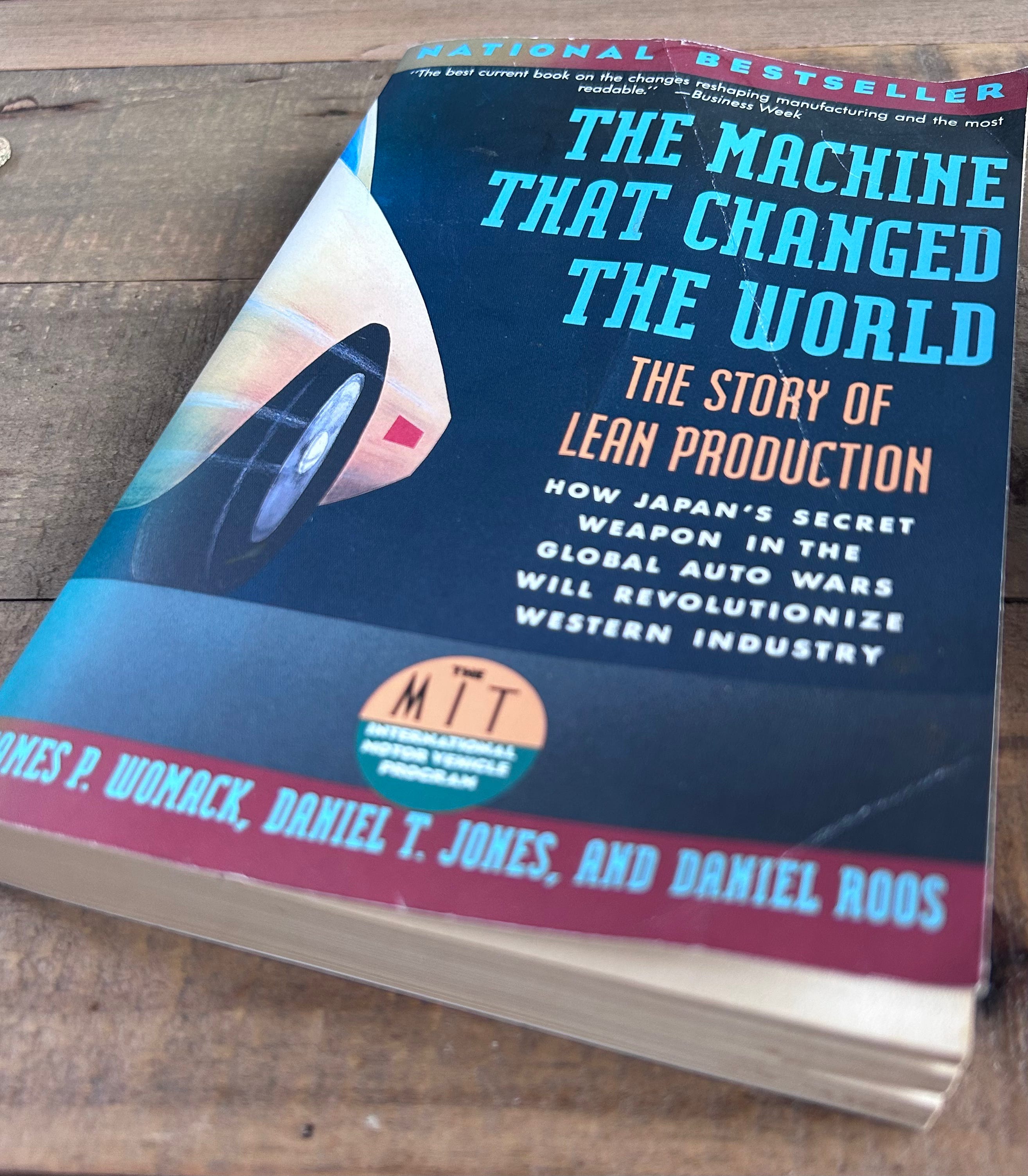
In the nineties for a good while this was it. As a business improvement manager with a large construction organisation, I took it between benchmarking and quality workshops, and like others relished in the new words, kanban, kaizen, lean, five why’s, seven wastes. We were not just adopting a new language though, we were converted by it.
There’s a personal journey folded into that cover. Quality management systems, Total Quality Management, Lean management, EFQM, BREEAM, ISO 9001, Benchmarking, my early years of improvement passing, where each framework promised to be the one that finally closed the gap between intention and delivery. Then the journey onwards from there into environmental management, sustainability, to the Living Building Challenge, to regenerative frameworks, biophilic patterns and imperatives, all of which looked, at the time, like arrival: standards and texts that finally asked for life itself, not just avoidance of harm.
It took Chounaird, Leopold, Kimmerer, then Meadows and more recently McGilchrist, to give me a certain clarity to question, to look back at those early lean years in a different light. Not wrong, I still think much of it was necessary, even good, for what it was. But perhaps our use of it, and where we let it sit in the hierarchy of what mattered, was our fault: mistaking the emissary’s all too excellent housekeeping for the vision itself.
And it was Charles Handy who showed me my route for consultancy practice, introducing a concept of sigmoid curve hopping, stay ahead of the decreasing curve, jumping into the next initiative, the next maturity to remain ahead of others. Now I see this as Meadows most impactful system leverage point, not becoming fixed on one paradigm on framework but having the flexibility to be open to and hold many.
Thirty years on, a different book sits alongside it, albeit as an ebook, McGilchrist’s The Master and His Emissary. 2And another question: Are we losing the permission to ‘feel’. What if the machine didn’t just change the world, what if it tool charge of which hemisphere, which half, of us was to runi it?
McGilchrist’s work, where the right hemisphere holds the world as it is, the living, particular, relational, what is never fully understood, and where the left hemisphere represents that world as fixed, spreadsheet, countable, useful, necessary, but only as the masters emissary, sent out, to measure and return.
And The Machine That Changed the World and lean production was the emissary’s masterpiece. Every source of variation was waste. Every process flow was to be mapped, standardised, charted, made visible in a manual or on a white board somewhere. And bear in mind this was with early computing power, often manual tracking. It worked, the book proved it with metrics and numbers, But what “worked” had already conceded: that a production system, a factory, a workforce, could be fully known through throughput and defect rates. The whole was reduced to what could be counted, and, this is the part we didn’t notice happening, or didn’t register and talk about, that the counting became the whole. The purpose. The Sustainability.
I don’t think this makes the book wrong. I think it makes the book a symptom. Lean didn’t invent left-hemisphere capture; it perfected its packaging beautifully, gave it a Japanese vocabulary and MIT endorsements, and sent it out to every improvement manager and consultant, and hence into every boardroom in the West, at the moment we most wanted permission to stop listening to anything that couldn’t be put on a spreadsheet tracker or into a Kanban system.
The right hemisphere’s throne of context, relationship, the tacit knowledge of the person, was handed over not by conquest but by consent.
We asked for frameworks then built our careers on them.
I have tried, over the years, way before knowing of regenerative or McGilchrist, to place something on that RH throne before the emissary was even let into the room. What today I call sensing before sense making:
An outdoor walk before a single LBC Imperative is explained, so the site is met with the knowing, way before it’s met with a framework checklist. An invitation to sense, to feel a future rather than be told what it will look like. Asking what does this place feel like in fifty years, not how does it certify. A council of all beings, an interspecies council, held before design starts, where the river and the fells and the fungi beneath the site, each given a voice, all so the brief is answered to something other than the clients or designers alone. And underneath all, the slower work of the Inner Development Goals and Regenerative Self, not a training programme for better practitioners, but an recognition that our regenerative self has to be practised in the person before it can be designed into a place.
None of these produce a deliverable in the LH’s currency. And I think that’s rather the point, They’re not stages that are typically seen as necessary, to precede the “real” design process. But, they are the RH hemisphere reoccupied, maybe imperfectly, before the emissary is sent back out to do what only he can do best: measure, sequence, track, build.
But here is a difficult area I reflect on now, in a sector still running the same operating system, with maybe adding a regenerative branding. Every regenerative framework, maturity matrix, ESG dashboard, “circular economy KPI” are all grand children of lean. It’s the same emissary with a new livery, moving further from the source and with each iteration more confident that it is the source.
We abuse land because we regard it as a commodity belonging to us. When we see land as a community to which we belong, we may begin to use it with love and respect.” Aldo Leopold
(Here Leopold names the exact move that lean/frameworks/matrices/spreadsheets perform, turning place into commodity and community into checklist)
Look closely and you see a family resemblance. The Living Building Challenge is regenerative practice’s most rigorous and honoured standard, and it is built, structurally, exactly like the machine that changed the world. Seven Petals in place of seven wastes. Twenty Imperatives in place of the standardised work sheet. Certification in place of a six sigma badge. It asks a building to prove itself through Place, Water, Energy, Health, Materials, Equity, Beauty . But the moment “Beauty” becomes an Imperative, maybe not measured, but with documentation requirements, the right hemisphere’s least measurable gift beauty has been folded back into the emissary’s ledger.
This isn’t a failure of LBC, whose authors who reached further toward a regenerative whole than anyone in the sector, it’s what happens to any wholeness once it is asked to prove itself through a checklist. The Petals don’t hold the flower. They replace it with a compartmentised taxonomy of what a flower would need to demonstrate.
What actually crosses is not better categorisation with ever finer granularity, but a return to attending before separation, to sensing before sense making. The wider picture, peripheral, sustained, relational attention of and to a place, a material, a community, before and yet independent of what a project will be monitored and scored on.
Kimmerer’s Honourable Harvest as always looms large in my thinking here, as one that cannot certify reciprocity; it practises it, in a relationship that precedes and exceeds any imperative written to be audited. This is a real intervention that lives at the level lean never reaches, a paradigm out of which metrics can arise, yet you cannot spreadsheet track or number crunch your way back to it, however many spreadsheets and petals you add.
Maybe we only now notice, I only notice now, that the Master throne has been empty for a very long time, and ask, what it would mean to place something on it that was never designed to be counted at all.
The book on the shelf isn’t wrong to be there, it was part of a journey. It just isn’t the whole story it once claimed to be, and neither, are we, thirty years further into the reign of the tool we mistook for the vision.
If this article resonates with you let me know, and if you would like to connect, or have a conversation how we might work together, please do reach out here
I was looking to read around the Leopold quote often paraphrased to ‘Think Like a Mountain’ the perspective of the mountain accumulated over centuries and that only the mountain has lived long enough to hear the howl of a wolf objectively

The Master and His Emissary

In many ways, this newsletter post has written itself and emerged from several cool coincidences. Regular conversations with Sophie Lacey over the last year have often touched on Iain McGilchrist’s Master and His Emissary and its importance in the context of regenerative thinking, principles and practice.