Three Days Into Summer
What a red alert heatwave reveals about a decade of climate action and the questions we still cant ask.
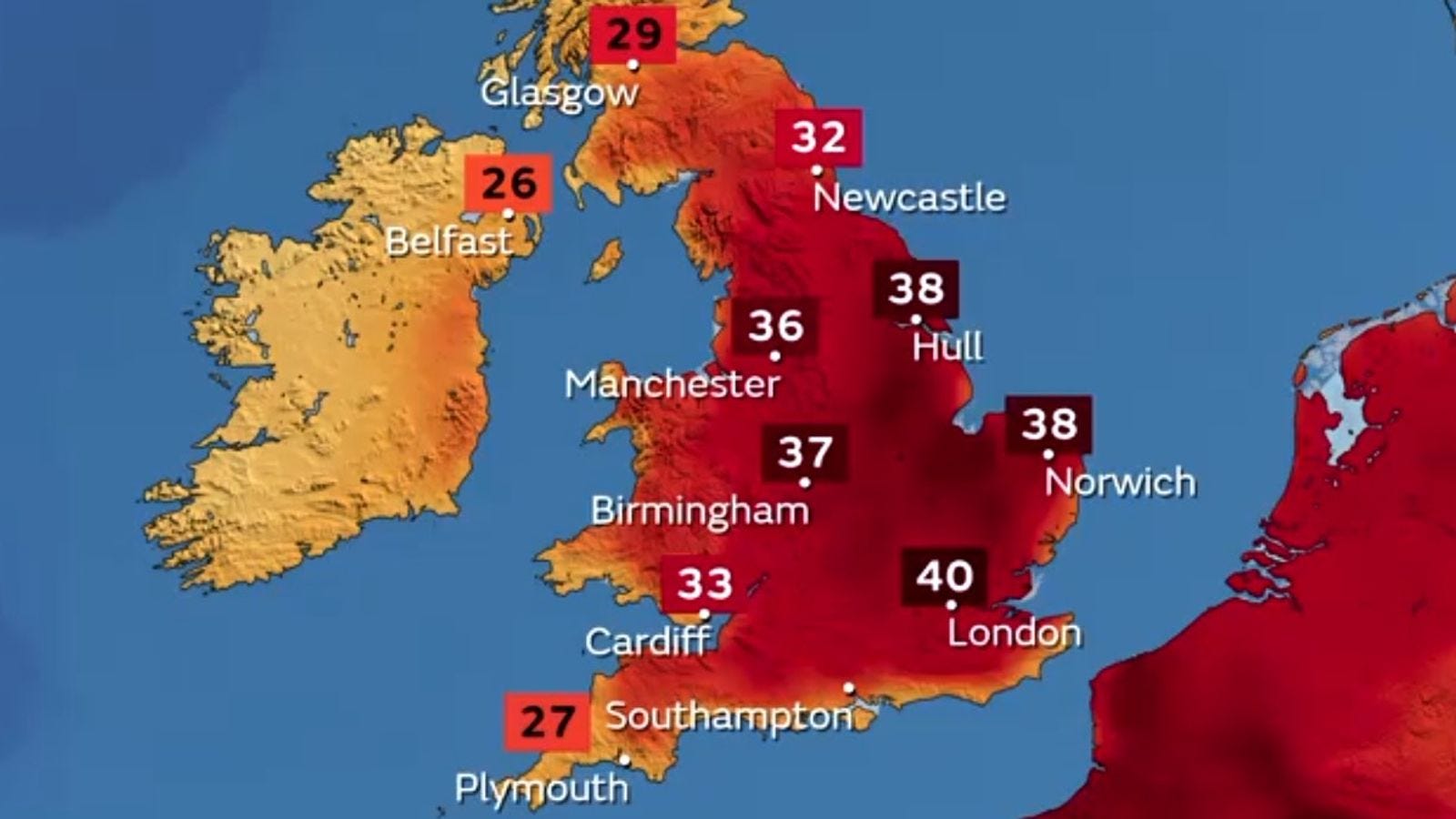
London Climate Action Week takes place this year within a red alert heatwave, the very consequence the week (and all climate action) exists to address, arriving as a felt, ambient fact rather than slide or forecast from any stage presentation. There’s a temptation to call this poetic irony, yet it’s something more diagnostic.
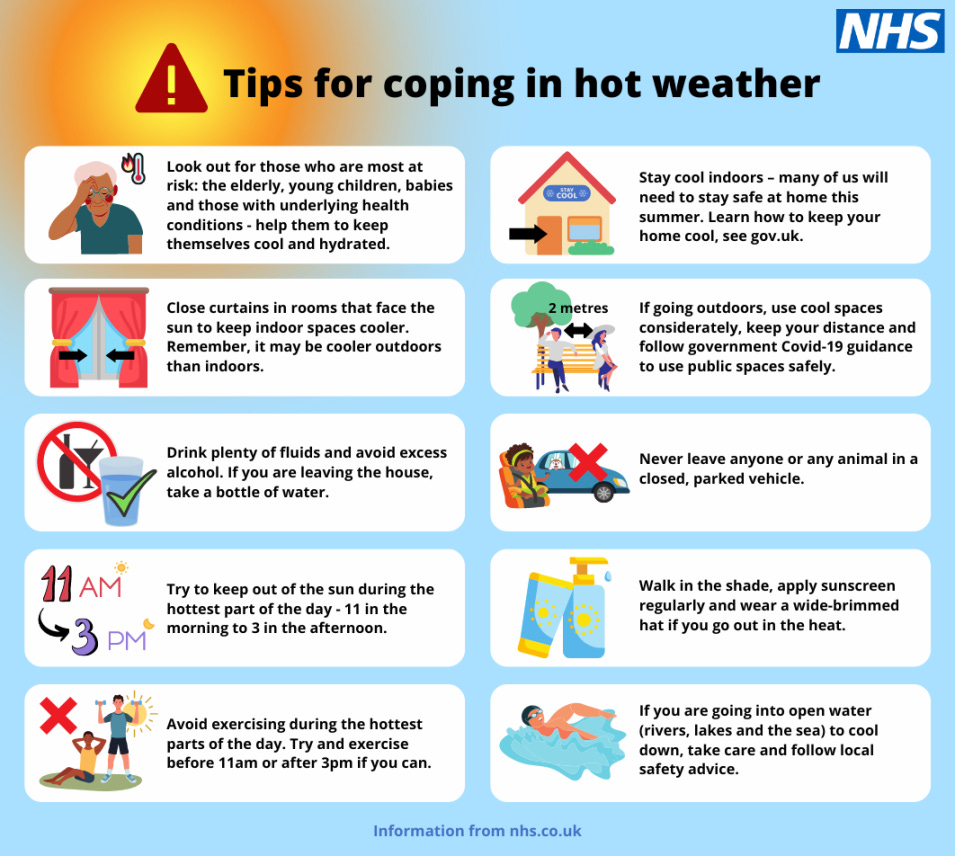
A number of schools are set to close as buildings cannot cope,
new-build homes, designed for cooler environment, struggle with ventilation,
high day temps will be accompanied by high humidity and very warm nights, making it hard for people to recover overnight,
homeowners are facing calls to limit their water usage,
transport cancellations and restrictions are forecast,
meetings and events being postponed.
And it’s only 3 days into summer or following the summer solstice
I have been exploring Donella Meadows’ leverage points and system thinking recently that enables a different system perspective, and combined with Iain McGilchrist’s hemisphere work, shows something alarming.
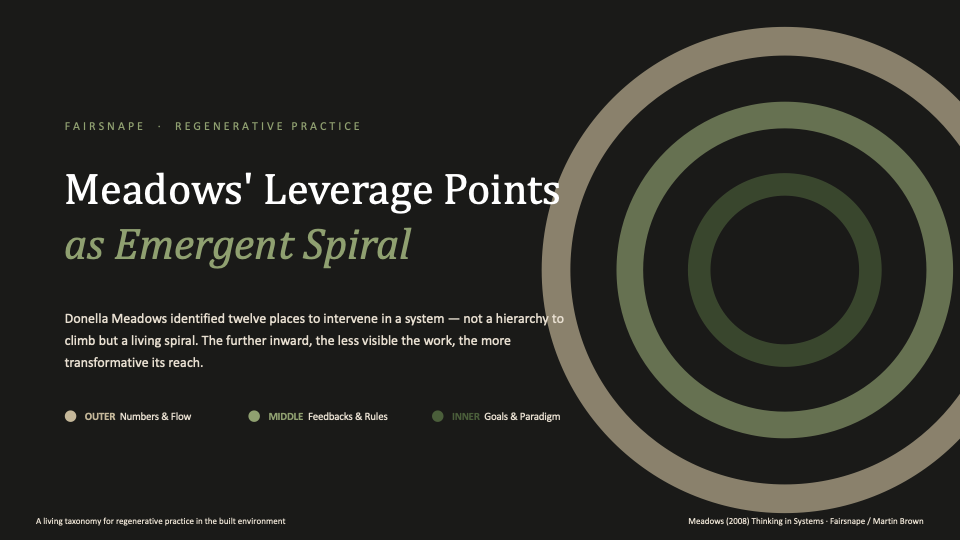
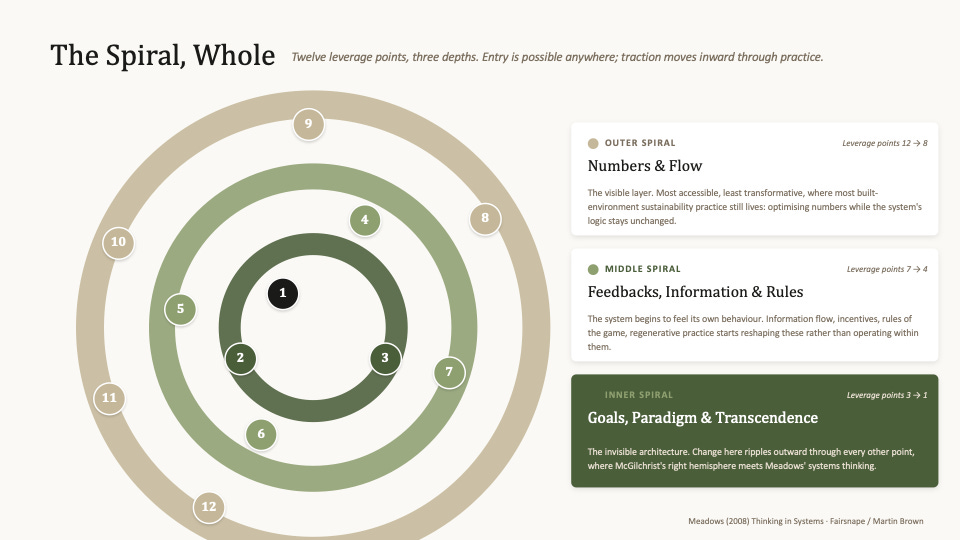
The flagship issues we are dealing with, finance, standards, disclosure, Carbon monitoring, AI-accelerated net zero, biodiversity net gain, even biophilic patterns, sit almost entirely at Meadows’ lower-leverage end of the existing (maybe dying) system. These are not unimportant. But they are Einstein’s trap, dressed as urgency: doing more of what we did a decade ago, expecting a different result.
It’s the most visible layer. The most fundable and the least transformative.
… Einstein’s trap, dressed as urgency: doing more of what we did a decade ago, expecting a different result …
We’ve had decades of hard-systems work, carbon accounting, green building standards, climate finance instruments, yet the needle on temperature and biodiversity has continued to move the wrong way .
And despite now talking about Nature as Partner, it remains structurally absent. We are poorly coped to talk about our relationship with nature and living systems - (compared to ease of talking about our relationship with other partners) and yet this is just the higher-leverage work needed,
Iain McGilchrist’s framing helps understand this precisely, our left hemisphere mode of attention (the grasping, quantifying, instrumentalising) has become Master where it should be Emissary, in service to a right hemisphere vision of living wholes, relationship and presence.
For us in the built environment specifically, this matters acutely, as in climate action context, we still default to monetary value, embodied carbon standards, BREEAM-style compliance …
… all necessary, but entry work in a sustainability/restorative/regenerative taxonomy context.
What’s missing are the higher tier questions, what is a building for, who or what has standing in our governance, what reciprocity do we owe to place and bioregion, what do we really return rather than merely reduce?
And who has the power to change the rules of the system …


The heatwave isn't an embarrassing coincidence for LCAW and climate action initiatives. It's the most honest item on climate agendas, proof that the decades of systems intervention, however well-intentioned, hasn't touched the paradigm that's actually driving the trend of red alert heat.
Heat memory:
The summer of 1976 is seared into national memory as one of record heat.
As an avid teenage climber I spent a few summer weeks in ‘76 in the Cairngorms, walking over Munros, climbing and swimming in lochs.
It was later however, much later, that I read The Living Mountain by Nan Shepherd, a book that has had so much influence on my views on sustainability, regenerative and outdoor life. Nan described the Cairngorms summer as being "as delectable as honey" or "as a roaring scourge". We discovered back then with sunburnt bodies, a scourge can mean heat and unbroken sunshine as much as bad weather.
She also shared much about her experience at Loch Avon (‘An), (where we swam, camping near the Shelter Stone) she wrote of wading directly into its freezing waters, "My spirit was as naked as my body. It was one of the most defenceless moments of my life"
Harvests failed, farmers despaired, Britain imported an extra million tonnes of grain, food prices rose by 12%, taps ran dry, and each day, 250 people died from heat-related deaths.
The heatwave, which began 50 years ago on Tuesday, brought 15 consecutive days on which the peak temperature was above 32C.
Half a century later and 32C no longer feels shocking.
On Monday the UK Health Security Agency (UKHSA) issued its second-ever red heat health alert for six regions of England, while the Met Office issued a rare red weather warning for Wednesday and Thursday. With temperatures predicted to pass 40C.
The Met Office has also issued a new projection of what a heatwave like that of the 1976 summer could look like in the 2050s. Under this modelling, the UK could see a 14-day heatwave event with temperatures of over 40C for nine consecutive days. Temperatures could peak at 45C in England, 38C in Scotland, 41C in Wales and 30C in Northern Ireland.
“This is only plausible because of high greenhouse gas emissions, the majority of which come from burning fossil fuels,” the Met Office said.